


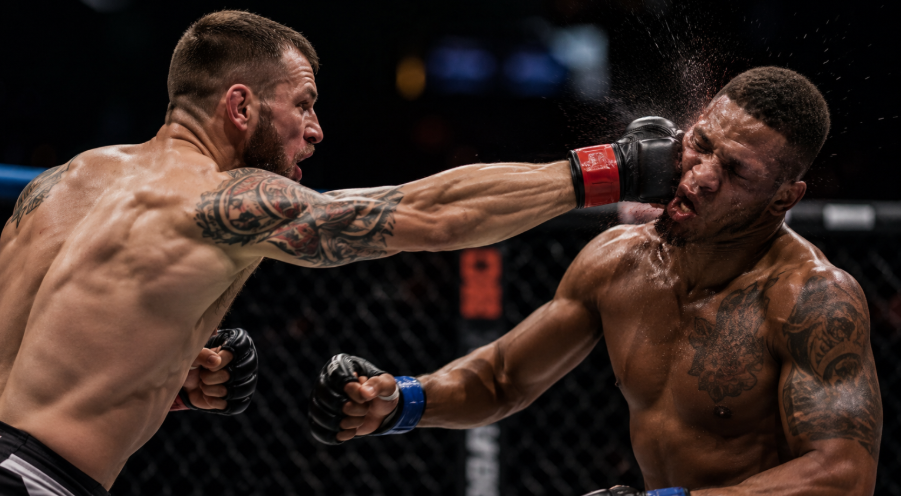
The knockout happened at 11:42 PM. By 11:43 PM, Twitter had already ruined the surprise for anyone watching on a standard ten-second delay. In the high-stakes world of combat sports, information doesn’t just travel; it detonates. Whether it is a devastating five-second knockout in the UFC octagon or a shocking, unannounced return at a major wrestling event, the magic of combat sports lies in its sheer unpredictability.
For the modern fan, however, the real fight often happens not just in the ring, but in the battle against technological lag. There is nothing more frustrating for a dedicated observer than a frozen screen just as a submission is locked in, or receiving a push notification spoiling a title change before the live broadcast catches up.
The Spoiler Economy and the Fragility of Real-Time
We live in the era of the ‘Spoiler Economy.’ In decades past, if you missed a live pay-per-view (PPV) broadcast, you might wait until the morning newspaper or a highlights show to see the results. Today, that luxury is gone. If your stream lags even fifteen seconds behind, you aren’t watching a live event; you are watching a ghost of what happened elsewhere.
This isn’t merely a minor technical inconvenience. It strikes at the heart of why we watch combat sports. When that experience is mediated by buffering wheels or degraded resolution, the impact of a landing strike or a referee’s count is diminished. As noted in recent industry breakdowns by MMA Fighting, the digital infrastructure for combat sports must prioritize speed over pure graphical fidelity to maintain this essential connection.
The Infrastructure Advantage: Why South Korea Leads the Way
If we look for the benchmark for reliable, high-speed digital infrastructure, the global consensus points toward South Korea. Renowned as a global IT powerhouse, the nation boasts the most stable and high-speed internet architecture in the world. This is not just about daily browsing speed; it’s about the unique capability to deliver real-time data streams without the catastrophic latency that plagues many global broadcasters.
In the streaming industry, infrastructure is destiny. Because South Korea has optimized its network for high-concurrency data transmission, platforms hosted on this foundation naturally outperform those relying on fragmented or aging international server nodes. This provides the backbone for the seamless, high-speed data transmission that is essential for live sports.
Performance-Driven Streaming: The Next Evolution
This search for speed often forces fans to navigate a fragmented landscape of platforms. Many international fans searching for Korean free sport broadcasts (스포츠중계) are now tapping into this Korean IT infrastructure to bypass local service failures.
While jgtvsports.com is a Korea-based service, it was engineered to dismantle the language barrier from the start. By providing full, native-level support for English-language broadcasts, the platform eliminates the friction typically associated with international streaming. Users aren’t forced to navigate complex, foreign interfaces; instead, they receive an intuitive viewing experience that feels as seamless as any domestic broadcast.
The ‘Second Screen’ as a Strategic Tool
This synergy—using a reliable streaming platform alongside a high-fidelity information hub like Fightful—is the new gold standard for the modern sports fan. We call this the ‘Second Screen’ experience.
Think of it as a strategic command center. On the primary screen, you have the raw, high-definition action. On the secondary device, you have the context. For the most dedicated enthusiasts, the ideal setup involves keeping the Fightful MMA Results page open on a second device or a side-by-side tab.
When you remove the variable of latency, you move from being a passive consumer to an active participant. By tracking live event updates alongside a zero-latency stream, you can observe a fighter’s fatigue levels, tactical shifts, and real-time outcomes the second they happen. This isn’t just entertainment; it’s an intellectual exercise that allows you to engage with the data while the action unfolds. It transforms the viewing experience from a passive event into a deep, integrated dive into the sport.
The Technical Reality: Why Latency Happens
To understand why a platform like JGTVSports stands out, one must understand why others fail. Latency is often a product of the content delivery network (CDN) failing to optimize for geographic distribution or simply overloading the server nodes.
Most services prioritize high-resolution bitrates over transmission speed. They send huge data packets that take longer to decode. Platforms that successfully achieve zero-latency streaming do the opposite; they optimize for packet transmission speed, sacrificing the minute visual details that the human eye can’t distinguish anyway, in favor of getting the signal to the viewer now.
This is the trade-off that successful broadcasters make. They understand that a fan would rather see a 1080p stream that is perfectly in sync with the arena than a 4K stream that is thirty seconds behind.
Elevating the Standard for the Future of Fandom
The industry is reaching a tipping point. As betting becomes further integrated into the viewing experience—via in-play wagering and live-prop betting—the cost of latency increases exponentially. A ten-second delay could be the difference between a successful hedge and a total loss.
We are moving toward a future where the broadcast is the foundation upon which every other digital interaction is built. If the foundation is delayed, the house falls. As sports fans, we should demand better. We should expect our technology to be as agile and responsive as the athletes we watch.
The digital landscape evolves, and the barrier to entry is no longer about finding a stream—it’s about finding a reliable one. By choosing platforms that prioritize technical stability and global access, you are not just choosing a way to watch; you are choosing to participate in the sport on your own terms. Keep your streams fast, keep your news sources current, and never settle for a delayed experience. The fight is happening right now—make sure you’re actually watching it.