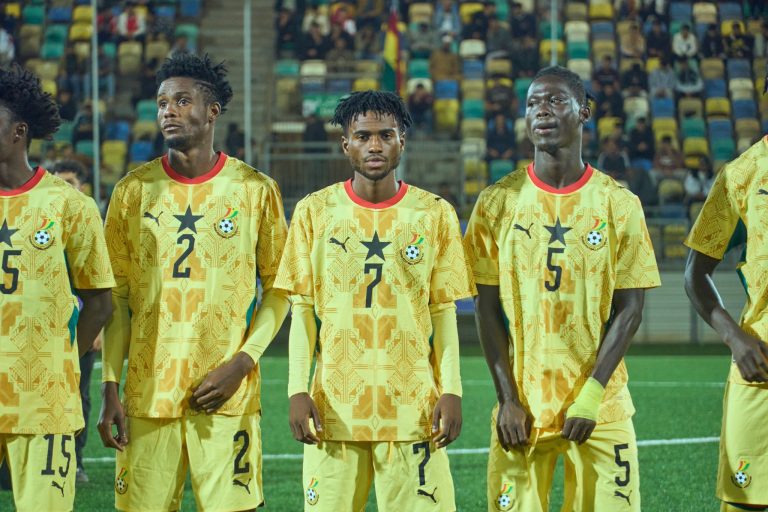


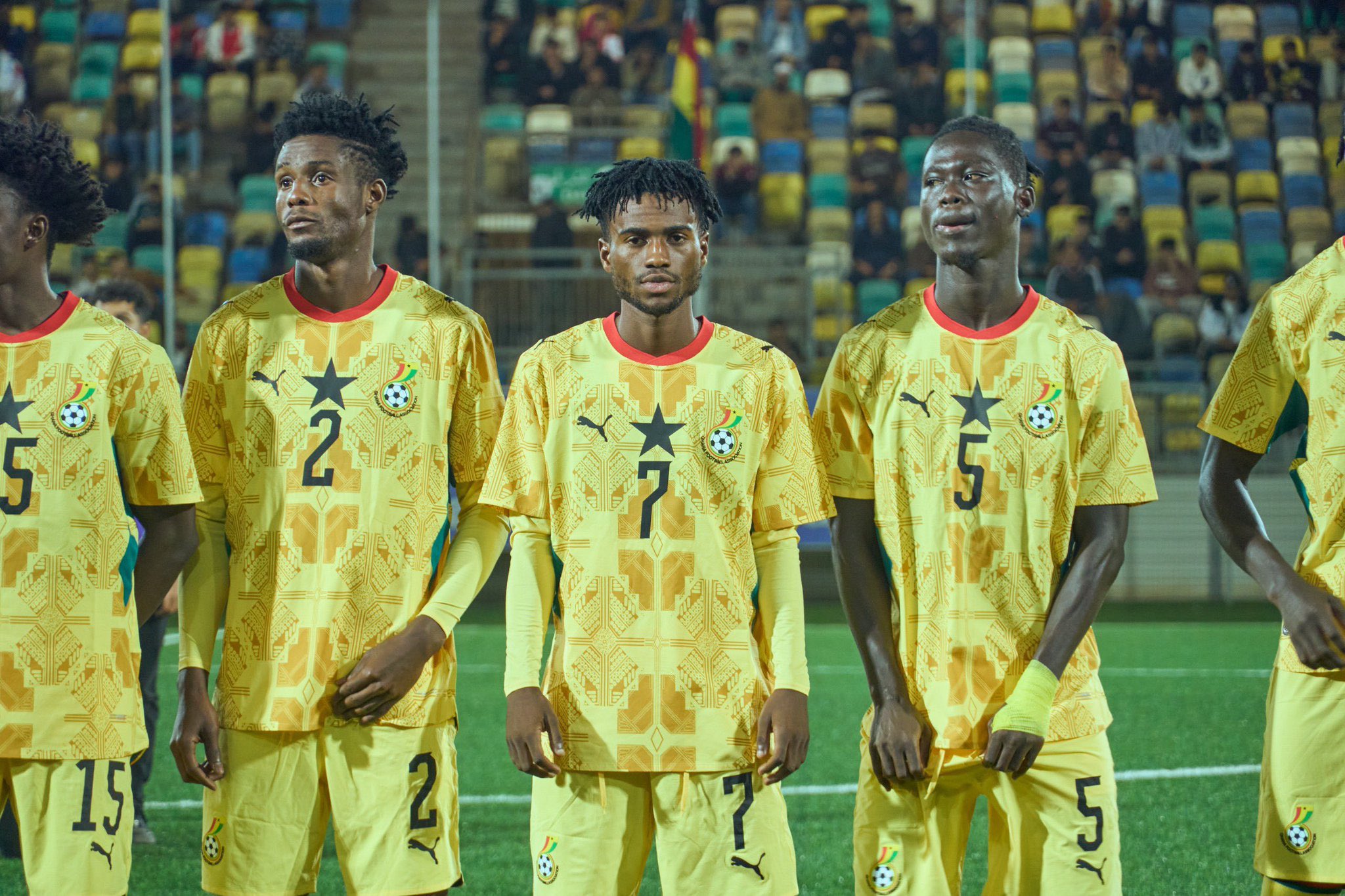
Ghana’s Black Meteors have placed their qualification hopes under serious pressure after suffering a disappointing 1-0 defeat to Libya in the first leg of their 2027 U-23 Africa Cup of Nations qualifying tie, leaving the team with a difficult task ahead of the return encounter in Accra.
The defeat is particularly painful because Ghana had an opportunity to manage the game and secure a more favourable result, even after being reduced to 10 men. However, the Black Meteors failed to demonstrate the defensive discipline and composure required to see out the encounter, allowing Libya to snatch a narrow victory.
For a team representing a country with Ghana’s football pedigree, the performance will raise serious questions about its ability to handle difficult moments in high-pressure matches. Playing with 10 men is never an easy assignment, but it demands greater concentration, organisation, sacrifice and tactical awareness. Unfortunately, Ghana could not maintain the necessary defensive structure to protect their goal.
The manner in which the winning goal was conceded will also be a major source of frustration for the technical team. It was a poor goal to give away, particularly at a stage when the Black Meteors needed to remain compact and avoid unnecessary mistakes. Such lapses can prove costly in two-legged competitions where every goal has the potential to determine a team’s fate.
The result leaves Ghana trailing by a goal, but the qualification battle is far from over. The Black Meteors still have the opportunity to correct their mistakes, respond to the setback and turn the tie around when both sides meet again on Ghanaian soil.
The return leg: Ghana’s opportunity for redemption
Attention will now shift to the return fixture, where the Black Meteors must produce a significantly improved performance if they are to keep their qualification ambitions alive.
Playing at home presents Ghana with an opportunity to take control of the tie. The players will have the backing of their supporters, and the technical team must use that advantage to build a performance capable of overturning the first-leg deficit.
A one-goal disadvantage is not an impossible mountain to climb. Ghana need to score at least once to draw level on aggregate, while a two-goal victory would secure qualification within normal time.
However, the biggest mistake the Black Meteors can make is approaching the return fixture with desperation. They must understand that scoring early would provide a significant psychological advantage, but patience and tactical discipline will be equally important.
Libya will not travel to Ghana simply to surrender their advantage. They are likely to adopt a cautious approach, frustrate the home side and look for opportunities to exploit spaces whenever the Black Meteors commit players forward.
This means Ghana must be intelligent in possession, move the ball quickly and create clear-cut opportunities rather than relying on hopeful attempts from distance.
Desmond Ofei faces a major tactical examination
The first-leg defeat presents head coach Desmond Ofei with an important opportunity to demonstrate his tactical ability and capacity to make adjustments under pressure.
His immediate responsibility will be to identify what went wrong in Libya, particularly the circumstances surrounding the goal Ghana conceded and the team’s response after going down to 10 men.
The dismissal also raises questions about discipline and decision-making. At this level of competition, unnecessary red cards can completely change the direction of a match. Ghana must show greater maturity and ensure that individual mistakes do not undermine the collective effort.
The technical team must also find the right balance between attacking ambition and defensive security. While the Black Meteors need goals, they cannot afford to become so desperate going forward that they leave themselves vulnerable at the back.
The return fixture will require a well-organised team capable of applying pressure, defending transitions and maintaining concentration throughout the contest.
Ghana’s Olympic dream at stake
Beyond the immediate disappointment, the importance of this qualification campaign cannot be underestimated.
The 2027 U-23 Africa Cup of Nations in Egypt is an important competition, with qualification also providing a pathway towards the 2028 Olympic Games in Los Angeles.
Ghana have a proud history in Olympic football, having won bronze at Barcelona 1992, becoming the first African country to reach the men’s Olympic football semi-finals.
However, the Black Meteors have not featured at the Olympic Games since Athens 2004. The country has therefore endured a lengthy absence from a competition in which it once made history.
The current generation has an opportunity to bring Ghana closer to a return to the Olympic stage, but that ambition will require consistency, commitment and the ability to deliver when the pressure is highest.
The defeat to Libya has made the journey more complicated, but it has not ended the dream.
Is there really hope for the Black Meteors?
Absolutely. A 1-0 defeat is recoverable, especially with a return fixture to be played in front of the home supporters. Ghana have the opportunity to rewrite the story, but they must produce a performance that reflects their ambitions.
The players must understand that reputation and history will not win the return encounter. Only hard work, tactical discipline, determination and clinical finishing will give them the result they need.
The technical team must also take responsibility for the shortcomings exposed in the first leg and ensure that the same mistakes are not repeated.
Ghanaian supporters have every reason to be frustrated with the result, particularly the manner in which the Black Meteors surrendered the game. Nevertheless, writing off the team at this stage would be premature.
The Black Meteors are one goal behind, not out of the competition. Their Olympic dream is still alive, but the return leg must be treated as a final.
Ghana need a response, and more importantly, they need a performance that restores confidence in the team’s ability to compete at the highest level of African youth football.