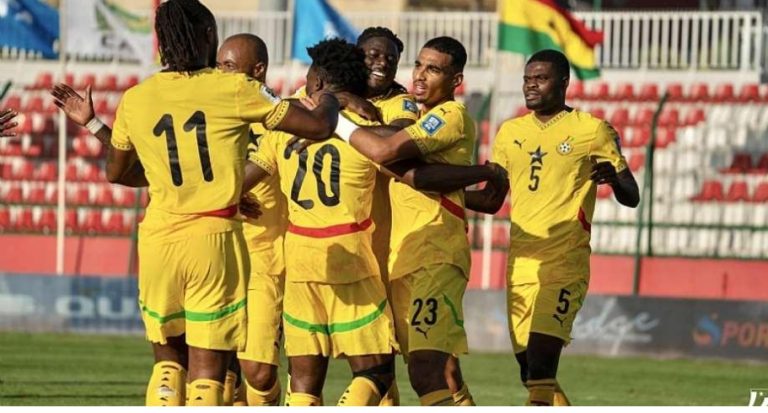


A penalty miss, an unconvincing first-half display and the familiar dependence on individual brilliance exposed the problems confronting Kim Lars Björkegren’s Black Stars despite their much-needed victory in Sekondi-Takoradi.
The Black Stars have finally remembered how to win, but whether Ghana have rediscovered how to play convincing football remains a much bigger question.
A 2-0 victory over Somalia at the Essipong Sports Stadium on Thursday, November 12, 2026, delivered the three points Ghana desperately needed in their 2027 Africa Cup of Nations qualifying campaign. However, beneath the celebrations, the goals and the temporary relief lies a national team still struggling to convince that it has the organisation, consistency and mentality required to compete at the highest level of African football.
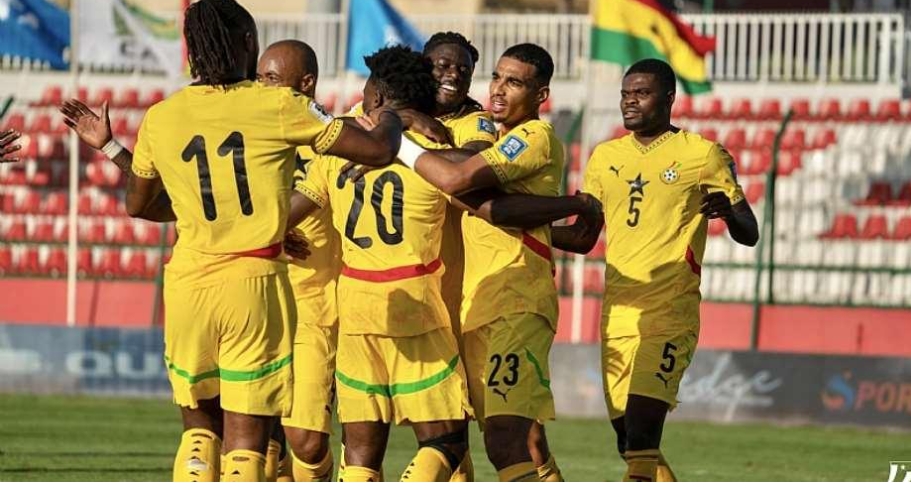
Jonas Adjetey and Felix Afena-Gyan scored the goals that rescued Ghana from another potentially embarrassing afternoon, but the performance also exposed why the Black Stars have found themselves in such a precarious position.
This was a match Ghana were expected to win. Somalia had entered the encounter without a point from their opening two qualifying fixtures, while Ghana were desperate to recover from defeats against Côte d’Ivoire and The Gambia.
Yet, even against an opponent of considerably less international pedigree, the Black Stars required a first-half stoppage-time breakthrough to take control of the contest.
The victory was necessary, but it should not be mistaken for evidence that the problems have disappeared.
For a country that has won the Africa Cup of Nations four times and consistently considers itself among the continent’s football powers, celebrating a home victory over Somalia as though a major obstacle has been conquered tells its own story.
Ghana’s standards have fallen, and the challenge facing interim head coach Kim Lars Björkegren is considerably bigger than collecting three points.
A national team that arrived in Sekondi with its reputation damaged
The Black Stars entered Thursday’s fixture carrying the consequences of two damaging results.
Their 2-0 defeat against Côte d’Ivoire was followed by an even more painful 4-2 loss to The Gambia, leaving Ghana without a point after the opening two matches.
The defeat against The Gambia was particularly alarming.
Ghana had scored twice but failed to protect their advantage, exposing defensive weaknesses and a worrying inability to manage difficult moments in a competitive international fixture.
The result raised questions about the team’s concentration, tactical discipline and leadership.
It also intensified scrutiny of the Ghana Football Association and the technical direction of the national team.
The appointment of Björkegren presented an opportunity to change the atmosphere, but the Swedish tactician inherited a side requiring more than minor adjustments.
Ghana needed a new sense of purpose, better tactical organisation and players prepared to accept responsibility.
The Somalia encounter was therefore an important examination of whether the Black Stars could respond to adversity.
They passed the immediate test on the scoreboard, but the performance offered reasons for both encouragement and concern.
The starting eleven: Experience, returning stars and the pressure to deliver
Björkegren opted for a 4-2-3-1 formation, selecting an experienced side capable of controlling possession and creating opportunities.
Benjamin Asare started in goal, with Alidu Seidu, Jonas Adjetey, Mohammed Salisu and Gideon Mensah forming the defensive line.
Thomas Partey and Caleb Yirenkyi occupied the central midfield positions, while Abdul Fatawu Issahaku, Mohammed Kudus and Felix Afena-Gyan operated behind captain Jordan Ayew.
The selection generated considerable interest because of Kudus’ return to the national team.
Kudus remains one of Ghana’s most influential attacking footballers, and his creativity was expected to provide the spark that had been missing during the opening two defeats.
Partey’s experience was also important in midfield, while Salisu offered defensive authority alongside Adjetey.
Ayew was handed the responsibility of leading the attack and providing the leadership expected of Ghana’s captain.
The lineup looked strong on paper.
However, having talented footballers is one thing; building a cohesive team capable of executing a clear tactical plan is another.
That distinction was evident during several passages of the first half.
Jordan Ayew’s penalty miss: Another reminder of Ghana’s attacking frustrations
The first major opportunity to settle the contest arrived when Ghana were awarded a penalty after Alidu Seidu was brought down inside Somalia’s penalty area.
It was the perfect opportunity for the Black Stars to take an early lead and relieve the pressure that had followed them into the stadium.
Captain Jordan Ayew stepped forward, but Somalia goalkeeper Ibrahim Ahmed Hussein denied him from the spot.
The save was a major moment in the contest and briefly threatened to turn the afternoon into another frustrating experience for Ghana.
For a team that had already struggled to convert its opportunities in the previous qualifiers, missing such an important chance was particularly damaging.
Ayew’s penalty miss also generated considerable criticism on social media, with some supporters questioning his current form and continued responsibility as the team’s attacking leader.
The criticism was harsh, but it reflected the growing impatience among supporters who have watched the Black Stars struggle to deliver consistently.
The captain eventually played a part in Ghana’s second goal, demonstrating that his contribution was not limited to the missed penalty.
Nevertheless, the incident reinforced an uncomfortable reality: Ghana cannot afford to squander clear opportunities and expect individual moments to rescue them in every match.
Against Somalia, the consequences were manageable. Against stronger opponents, such inefficiency could prove decisive.
Adjetey rescues a frustrating first half
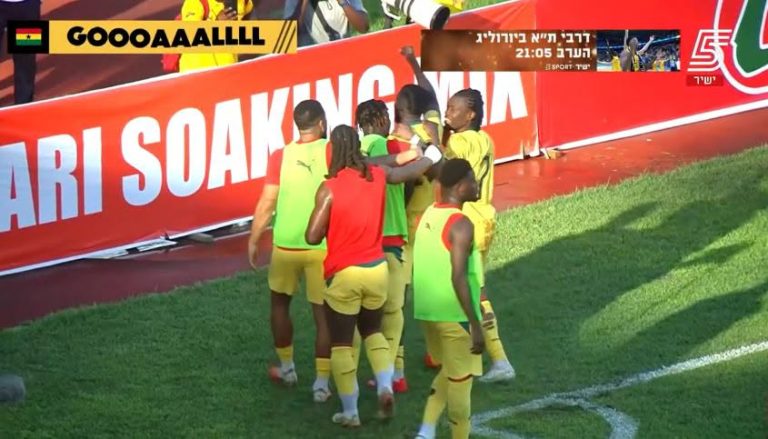
Just when the Black Stars appeared destined to enter the interval with another disappointing scoreline, Jonas Adjetey delivered the breakthrough.
The defender rose above the Somali defence to head home from a corner-kick routine involving Mohammed Kudus and Mohammed Salisu.
The goal arrived in first-half stoppage time and transformed the atmosphere inside the stadium.
Adjetey had done what Ghana’s attacking players had struggled to achieve for much of the opening period.
There was something particularly revealing about the fact that a central defender had to provide the breakthrough against Somalia.
It highlighted the difficulties Ghana experienced in turning their possession and attacking intentions into clear goalscoring opportunities.
Adjetey deserves credit for his contribution, but the Black Stars must develop a more reliable attacking structure that does not depend on defenders rescuing them from difficult situations.
Afena-Gyan provides the insurance, but questions remain
Ghana needed a second goal to remove any lingering uncertainty, and Felix Afena-Gyan delivered in the 62nd minute.
The forward finished a counterattacking move after Jordan Ayew found Mohammed Kudus, who supplied the decisive pass.
It was a well-timed contribution that gave Ghana the breathing space they desperately needed.
Afena-Gyan’s goal was important not only because it secured the result but also because it demonstrated the value of direct attacking transitions.
The Black Stars had struggled to break down Somalia in the first half, but the second goal showed how quickly they could punish an opponent when the attacking movement was effective.
However, the question remains whether Ghana can reproduce that efficiency against teams with greater defensive quality.
A victory over Somalia is welcome, but it cannot be used as the ultimate measure of the team’s progress.
The Black Stars need to demonstrate that their attacking combinations can work against Côte d’Ivoire, The Gambia and other established African sides.
Kudus returns, Kyereh reappears, but Ghana still need a collective identity
The return of Mohammed Kudus was one of the biggest positives from the encounter.
His involvement in Adjetey’s goal and the build-up to Afena-Gyan’s strike demonstrated why his creativity is important to the national team.
Kudus offers Ghana something different: the ability to carry the ball, create space, beat opponents and produce decisive passes in congested areas.
His partnership with Fatawu and the other attacking players could become an important component of Björkegren’s tactical plans.
Another notable development was the introduction of Daniel Kofi-Kyereh in the 75th minute.
The midfielder returned to the Black Stars after almost four years away from the national team.
He nearly marked his comeback with a spectacular long-range effort in the 77th minute, but Somalia’s goalkeeper produced a save.
His return provides another midfield option, although the technical team must carefully assess how best to integrate him into the side.
The challenge is to turn these individual talents into a functioning collective.
Ghana have had talented players in previous campaigns, yet talent alone has never guaranteed success.
What the Black Stars need is a recognisable football identity, tactical discipline and consistency across all areas of the pitch.
Both teams’ starting line-ups
Ghana – 4-2-3-1
Benjamin Asare; Alidu Seidu, Jonas Adjetey, Mohammed Salisu, Gideon Mensah; Thomas Partey, Caleb Yirenkyi; Abdul Fatawu Issahaku, Mohammed Kudus, Felix Afena-Gyan; Jordan Ayew (captain).
Somalia – 4-4-2
Ibrahim Ahmed Hussein; Faisal bin Othman Omar, Ali Omar, Abel Gigli Mohamed, Mohamed Mohamed; Sakariya Hassan, Abdisamad Abdullahi, Abdulrahman Sharif, Mubashir Nour; Bilal Elmi Njie, Musse Jailani Bile.
The second half brought relief, but the defensive questions have not disappeared
After the interval, Ghana continued pushing for another goal, with Mohammed Salisu coming close through a header from a corner.
The Black Stars eventually secured their second through Afena-Gyan, but Somalia continued searching for a response.
Ghana managed the remaining stages of the contest and introduced fresh players, including Prince Adu Kwabena, Daniel Kofi-Kyereh, Ibrahim Sulemana, Rahim Ibrahim and Brandon Thomas-Asante.
While the substitutions helped the team manage the closing stages, the technical team must continue working on the defensive organisation that failed the Black Stars against The Gambia.
A clean sheet against Somalia is positive, but it is not sufficient evidence that the defensive problems have been solved.
The real examination will come against opponents capable of exploiting spaces, pressing aggressively and punishing defensive mistakes.
Ghana’s AFCON 2027 campaign: Three points cannot erase the damage
The victory takes Ghana to three points after three Group C matches, following defeats against Côte d’Ivoire and The Gambia.
That leaves the Black Stars with considerable ground to recover.
With the top two teams in the group qualifying for the tournament, Ghana cannot afford another prolonged period of inconsistency.
The 2027 Africa Cup of Nations will be hosted by Kenya, Tanzania and Uganda, and missing the tournament would represent another significant disappointment for a country with Ghana’s football history.
The Black Stars have already endured a difficult period in recent international competitions.
Supporters are increasingly demanding more than promises, coaching changes and isolated victories.
They want a national team that competes with conviction, respects the country’s football heritage and demonstrates the ability to win important matches.
The victory over Somalia provides a foundation, but the campaign remains far from secure.
Björkegren’s real examination is only beginning
Björkegren deserves credit for securing his first competitive victory with the Black Stars.
He also deserves recognition for giving returning players opportunities and getting a positive result at a moment when Ghana desperately needed one.
However, the Swedish coach must understand that beating Somalia is the minimum expectation, not the ultimate achievement.
He must develop a team capable of competing against the strongest sides in Africa, improve Ghana’s attacking efficiency, establish a reliable defensive structure and create an environment in which players understand their responsibilities.
The next meeting against Somalia on November 16 offers an opportunity to complete the double-header with another victory.
But beyond the result, supporters will want to see improvement in the quality of football.
Ghana cannot continue treating every victory as a major achievement while ignoring the structural problems that have contributed to their decline.
The verdict: A win worth celebrating, but not a performance worth romanticising
The scoreboard reads Ghana 2-0 Somalia.
Jonas Adjetey delivered the breakthrough, Felix Afena-Gyan provided the insurance, and the Black Stars finally collected their first three points of the qualifying campaign.
But the missed penalty, the prolonged wait for the opening goal and the questions surrounding the team’s overall organisation should not be swept aside by the celebrations.
The Black Stars have bought themselves some breathing space.
They have not yet earned back the confidence of an increasingly impatient football nation.
For Björkegren, the task is now clear: transform this victory into the beginning of a genuine revival rather than another temporary escape from criticism.
Ghana’s football reputation cannot be restored by beating Somalia alone.
The Black Stars have won the match. The battle to restore the Black Stars has only just begun.