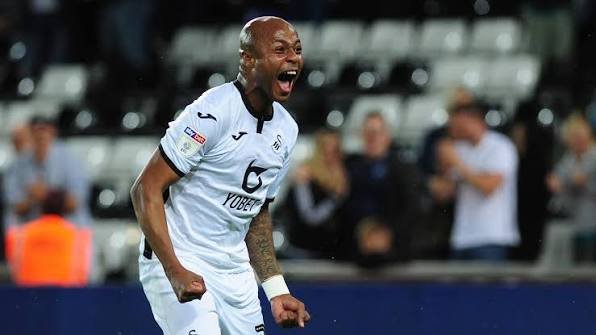



Former Ghana captain André Ayew has reflected on the painful ending to the Black Stars’ historic 2010 FIFA World Cup campaign, insisting that the team never blamed Asamoah Gyan for missing the decisive penalty against Uruguay.
Ayew said Ghana’s disappointment following the quarter-final elimination was directed at the circumstances surrounding Luis Suárez’s controversial handball rather than Gyan, who had carried the nation’s hopes throughout the tournament.
The former Olympique de Marseille and Swansea City winger believes Suárez’s deliberate intervention on the goal line not only denied Ghana a potential place in the semi-finals but also crushed the hopes of millions of football fans across Africa.
Speaking on the Obione Podcast, Ayew explained that the squad remained appreciative of Gyan’s contribution to their remarkable run and did not consider him responsible for their elimination.
“We weren’t angry at Baby Jet [Asamoah Gyan]. Without him, we wouldn’t have got that far. Suárez’s handball killed the hopes of not just Ghana, but the whole continent. We believed we could surprise the world.”
Ayew’s comments revisit one of the most dramatic and controversial moments in World Cup history, when Ghana came agonisingly close to becoming the first African nation to reach the semi-finals of the competition.
A moment that changed Ghana’s World Cup dream
Ghana entered the 2010 World Cup in South Africa carrying the hopes of a continent eager to see an African team make history on football’s biggest stage.
Under Serbian coach Milovan Rajevac, the Black Stars progressed from a challenging group containing Germany, Australia and Serbia to reach the knockout stages.
Despite being one of the youngest teams at the tournament, Ghana demonstrated resilience, tactical discipline and attacking quality, earning admiration for their performances.
The Black Stars defeated the United States 2-1 after extra time in the round of 16, with Gyan scoring the winning goal to send Ghana into the quarter-finals for the first time in their history.
That victory placed Ghana within touching distance of a historic semi-final appearance, with Uruguay standing between the team and a place among the final four nations.
Gyan had emerged as one of Ghana’s most influential players during the tournament, scoring crucial goals and providing the attacking threat that helped the team progress through the competition.
His importance to the campaign is central to Ayew’s defence of his former teammate, particularly given the criticism Gyan faced after the quarter-final defeat.
Suárez’s handball and the penalty that followed
The quarter-final between Ghana and Uruguay, played on July 2, 2010, at Soccer City in Johannesburg, produced a tense contest that remained level at 1-1 after extra time.
Ghana had taken the lead through Sulley Muntari’s long-range strike in first-half stoppage time before Diego Forlán equalised for Uruguay with a free-kick early in the second half.
With neither side able to find a winner during normal time, the match went into extra time, where Ghana pushed hard for the goal that would send them into the semi-finals.
The decisive moment came in the final seconds of extra time when a goal-bound header from Dominic Adiyiah was blocked by Uruguay forward Luis Suárez on the goal line.
Suárez deliberately used his hands to prevent the ball from entering the net, an act that resulted in a straight red card and a penalty for Ghana.
The Black Stars were presented with a golden opportunity to secure victory and make history. Gyan stepped forward to take the resulting penalty, but his powerful effort struck the crossbar and bounced back into play.
The miss forced the contest into a penalty shootout, where Uruguay prevailed 4-2 to eliminate Ghana from the tournament.
For Ghana, the outcome was devastating. The team had come within seconds of securing a place in the semi-finals, only for the opportunity to slip away in the most painful circumstances.
Why Ayew says Ghana never blamed Gyan
Ayew’s remarks highlight the distinction between disappointment over a missed penalty and the appreciation of a teammate’s overall contribution.
Gyan had been instrumental in Ghana’s progress through the tournament, scoring three goals and repeatedly delivering when the team needed him.
His penalty miss against Uruguay became one of the defining images of the 2010 World Cup, but Ayew’s account makes clear that the players understood the wider context of their campaign.
Rather than blaming Gyan for the elimination, Ayew emphasised that Ghana would not have reached that stage without the striker’s contribution.
The penalty was a high-pressure moment in which the outcome could have transformed Ghanaian and African football history. Even the most accomplished players can miss penalties, and Gyan’s miss came after he had already played a significant role in bringing Ghana to the brink of the semi-finals.
Ayew’s defence also reflects the collective nature of Ghana’s achievement. The Black Stars had advanced through the group stage and defeated the United States through the efforts of the entire squad, with Gyan among the players who made the difference.
The former captain’s comments therefore serve as a reminder that the disappointment of the Uruguay defeat should not erase the achievements of the players who represented Ghana in South Africa.
A lost opportunity for Ghana and Africa
Beyond Ghana’s national ambitions, Ayew believes the incident carried wider significance for African football.
Ghana were the only African team to reach the quarter-finals of the 2010 tournament, which was the first World Cup hosted on the continent. Their progress had generated enormous excitement among supporters who hoped the Black Stars could deliver an unprecedented achievement.
A semi-final appearance would have made Ghana the first African nation to reach that stage of the men’s FIFA World Cup, setting a landmark for the continent.
Cameroon and Senegal had previously reached the quarter-finals, in 1990 and 2002 respectively, but neither had progressed further. Ghana had the opportunity to break that barrier in South Africa.
Ayew’s statement that Suárez’s handball killed the hopes of the whole continent reflects the magnitude of what was at stake. The incident was not simply a controversial moment in a football match; it occurred when Ghana stood one successful penalty away from moving closer to an achievement that African football had pursued for decades.
Although the handball was punished according to the Laws of the Game, with Suárez sent off and Ghana awarded a penalty, the subsequent miss and shootout defeat meant the Black Stars could not capitalise on the opportunity.
Uruguay eventually reached the semi-finals, while Ghana were left to contemplate what might have been.
Ghana’s historic campaign remains significant
Despite the painful conclusion, Ghana’s 2010 World Cup performance remains one of the most memorable chapters in the country’s football history.
The team demonstrated that African sides could compete against established football powers and challenge for places in the latter stages of the World Cup.
Ayew, who was part of the squad, experienced the campaign as a young player before later becoming one of the senior figures in the Black Stars setup.
His reflection on the Suárez incident underscores the emotional weight of the defeat and the lasting impact it had on the players and supporters.
More than a decade later, the debate surrounding the handball, Gyan’s missed penalty and Ghana’s elimination continues to evoke strong emotions among football fans.
However, Ayew’s message is clear: Gyan should be remembered for what he contributed to Ghana’s historic run, not solely for the penalty he missed.
The former captain believes the team had earned the right to dream of making history, and that the circumstances of their elimination made the defeat especially difficult to accept.
As Ayew recalled, the Black Stars were not merely competing for a place in the semi-finals; they believed they could surprise the world and achieve something unprecedented for African football.
That ambition remains at the heart of Ghana’s 2010 World Cup story — a remarkable campaign that came within seconds of making history, but ended in one of the most heartbreaking defeats the country has ever experienced.