

On Sunday, May 17, 2026, the pews of All Saints Anglican Church will not be occupied by only worshippers in the traditional sense. Sitting quietly beneath stained glass windows and sacred hymns will be football administrators, government officials, coaches, players, sponsors, and stakeholders — all gathered for one purpose: prayer.
It is not a cup final.
It is not a trophy presentation.
It is not even matchday.
Yet, in many ways, it may become one of the most important events on Ghana football’s calendar.
The Ghana Football Association, together with the Ministry of Sports and Recreation, has chosen to pause football activities and turn toward faith, thanksgiving, and divine guidance ahead of the 2026 FIFA World Cup and other major assignments involving Ghana’s national teams.
And perhaps that raises a bigger question — one that has followed football for generations:
Does football really have something to do with divine intervention?
For some, the answer is obvious. For others, it sounds absurd. But in Ghana, Africa, and many parts of the football world, spirituality and sport have never truly been separated.
Football may be played on grass, but millions believe outcomes are also decided beyond the touchline.
A Game That Constantly Escapes Human Explanation
Football is perhaps the most emotional sport on earth because it consistently produces moments logic cannot explain.
How does a tiny nation defeat a global powerhouse?
How does a striker miss an open goal one minute and score an impossible winner the next?
How does a team survive wave after wave of attacks and still emerge victorious with a single shot on target?
Fans call it luck.
Players call it destiny.
Coaches call it belief.
Religious people often call it God.
Throughout football history, players have pointed to heaven after scoring. Coaches have knelt in prayer before penalties. Entire nations have fasted ahead of crucial matches. Some clubs even travel with chaplains and spiritual advisers.
In Africa especially, football is deeply spiritual.
Victories are celebrated as blessings. Defeats are examined like mysteries. Injuries, collapses in form, and shocking losses are often discussed not only tactically but spiritually.
That is why the upcoming national thanksgiving service does not surprise many Ghanaians. To them, football is bigger than tactics and talent alone.
It is emotional.
It is cultural.
And sometimes, deeply spiritual.
Ghana’s Relationship With Football and Faith
Few countries connect football and faith like Ghana.
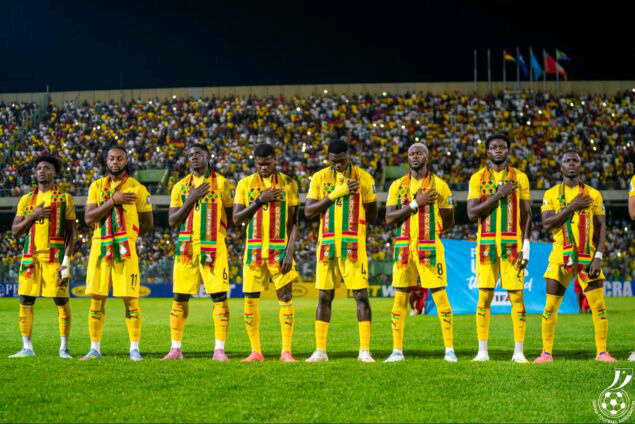
From local colts football to the Black Stars, prayer is almost inseparable from preparation. Before kick-off, players gather in circles. Christian prayers are offered. Muslim prayers follow. Crosses are made. Hands are lifted. Eyes are closed.
Even fans participate spiritually.
Churches organise special prayer sessions before major tournaments. Mosques pray for victory. Prophets issue predictions. Radio stations invite spiritual leaders to speak about the national team.
Whether one believes in divine intervention or not, faith undeniably occupies a central place in Ghanaian football culture.
This latest gathering organised by the GFA reflects exactly that national mindset.
Led by GFA President Kurt Edwin Simeon-Okraku and Sports Minister Kofi Adams, the service seeks prayers not only for the Black Stars but also for the Black Princesses, Black Starlets, Black Maidens, and Ghana’s growing domestic leagues.
On the surface, it is a thanksgiving service.
But beneath that lies something deeper: an acknowledgment that football sometimes feels too unpredictable, too emotional, and too powerful to be controlled by human effort alone.
The Thin Line Between Preparation and Providence
Modern football is built on science.
Teams analyse data. Nutritionists monitor diets. GPS trackers measure movement. Coaches study opposition videos for hours. Clubs spend millions on sports psychology and performance analytics.
Yet after all the planning, football still finds ways to humble experts.
A referee’s decision changes history.
A deflection ruins years of preparation.
A miracle save transforms careers.
A single injury alters an entire tournament.
This uncertainty is precisely why many football people continue to lean on faith.
Not because they reject hard work, but because football repeatedly reminds humanity of its limitations.
Even elite managers admit there are moments they cannot explain.
Sir Alex Ferguson famously spoke about “football gods.”
Players often describe feeling “chosen” during extraordinary performances.
Fans speak about fate as if it were another player on the pitch.
Perhaps faith becomes football’s response to uncertainty.
Because when everything else fails to make sense, people search for something greater than themselves.
Divine Intervention or Psychological Strength?
Of course, skeptics argue that religion does not influence football results.
According to this view, prayer does not score goals. Training does. Tactical discipline does. Quality players do.
And they have a point.
If prayer alone won tournaments, the most religious nations would dominate world football permanently. That has clearly not happened.
But supporters of spiritual preparation often make a different argument entirely.
They say faith may not magically change scorelines, but it changes people.
Prayer calms anxiety.
Faith strengthens belief.
Spiritual unity builds confidence.
Hope helps players endure pressure.
In that sense, divine intervention may not always appear as supernatural miracles. It may instead operate through human resilience, emotional strength, and mental clarity.
A confident player performs differently from a fearful one.
A united team fights harder than a divided one.
A hopeful nation supports more passionately than a hopeless one.
Perhaps spirituality shapes football indirectly rather than magically.
And perhaps that is why even highly professional football environments still preserve moments of prayer.
Africa’s Football Spirituality Cannot Be Ignored
Across Africa, stories linking football to spirituality are endless.
Players consult pastors before tournaments.
Families organise fasting sessions.
Communities pray through the night before decisive qualifiers.
Some of these practices attract criticism. Others become controversial. But they persist because football carries enormous emotional weight across the continent.
For many African families, football is not merely entertainment.
It is survival.
It is national pride.
It is identity.
It is hope.
When stakes become that high, people naturally search for divine assistance.
That may explain why Ghana’s prayer gathering feels culturally natural rather than unusual.
In Europe, such an event might be treated as symbolic. In Ghana, many will view it as necessary.
The Black Stars and the Burden of Belief
No Ghanaian team carries spiritual expectation more heavily than the Black Stars.
Every World Cup qualification revives memories of past glory and heartbreak. The near-miss against Uruguay in 2010 still feels spiritual to many supporters — a moment suspended painfully between destiny and disappointment.
When Ghana qualifies for global tournaments, citizens often speak in emotional and almost sacred language.
The team does not simply represent football. It represents the soul of the nation.
That burden explains why prayers for the Black Stars remain constant.
As Ghana prepares for another FIFA World Cup journey, the national thanksgiving service becomes more than ceremony. It becomes a national emotional reset — a way of uniting football and faith before the world watches again.
Perhaps Football Has Always Been About Faith
Maybe the real question is not whether divine intervention exists in football.
Maybe the real question is whether football itself is built on faith.
Think about it.
Fans believe every new season could be different.
Players believe they can overcome impossible odds.
Nations believe eleven people can unite millions emotionally.
Football survives because people believe.
And belief — whether in God, destiny, miracles, or possibility — is spiritual at its core.
That may be why football and religion often resemble each other. Both create devotion. Both inspire rituals. Both gather communities. Both produce tears, joy, sacrifice, and hope.
On Sunday in Accra, when church bells ring and football officials bow their heads in prayer, critics may dismiss it as symbolism.
But others will see something profound.
A reminder that even in a modern game dominated by money, technology, and statistics, humanity still searches for something higher.
Because after tactics fail, after predictions collapse, and after logic runs out, football still leaves room for mystery.
And perhaps that mystery is exactly why the world continues to love it.