

There was a time when watching the Black Stars was an experience that carried a certain emotional assurance, because even when Ghana lost a match, supporters could often point to something encouraging in the performance and believe that the team had the quality, character and determination to recover in the next encounter. The Black Stars could lose to a stronger opponent without appearing completely overwhelmed, and there was usually an understanding that Ghana possessed players capable of competing with the best on the continent. Today, however, that confidence has been replaced by uncertainty, frustration and, increasingly, genuine concern about where the national team is heading.
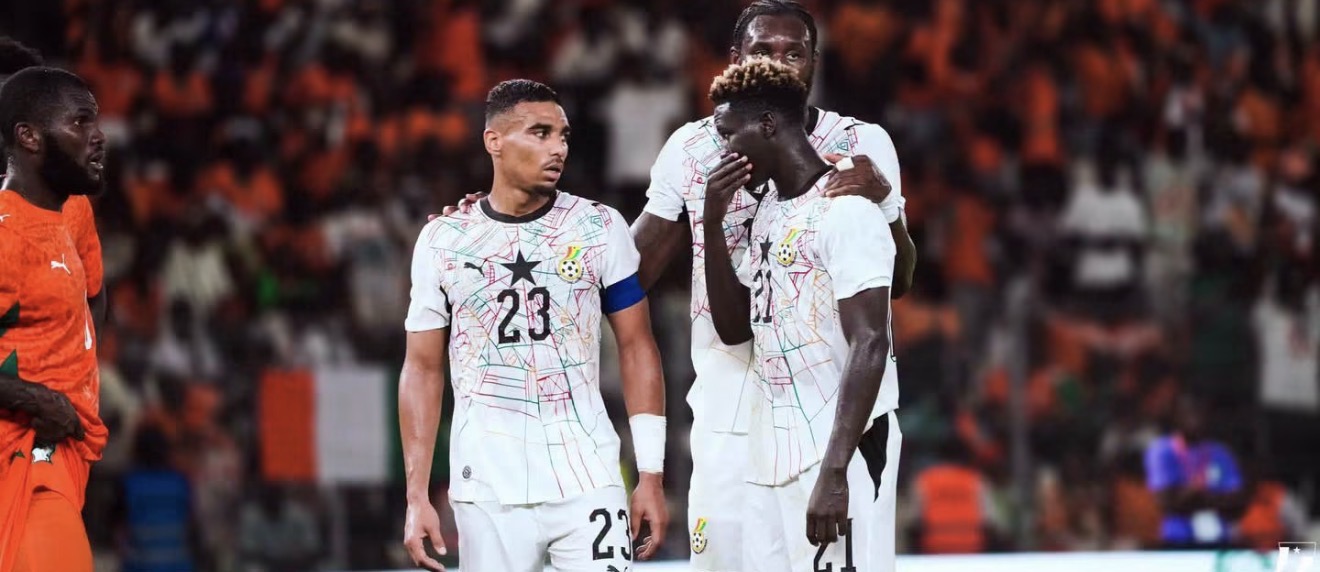
The latest 2–0 defeat to Côte d’Ivoire in Bouaké has once again brought those concerns to the surface, not merely because Ghana lost an important Africa Cup of Nations qualifying match, but because of the manner in which the defeat unfolded. Côte d’Ivoire deserved their victory, but what made the result particularly painful for Ghanaian supporters was the feeling that the Black Stars struggled to impose themselves on the contest for long periods. There was very little authority in Ghana’s play, the midfield struggled to establish control, the attack lacked sufficient penetration and the team appeared to spend too much time reacting to the Ivorians instead of forcing them to respond to Ghana.
For a country with Ghana’s football tradition, that should be deeply uncomfortable. The Black Stars have historically been regarded as one of the major football powers in Africa, and although Ghana have experienced difficult periods before, there was always a sense that the national team possessed an identity and a competitive spirit that could make it dangerous against any opponent. That identity has become increasingly difficult to recognise, and the most troubling part of the current situation is that Ghana’s struggles can no longer be described as the result of one bad tournament, one unfortunate match or one poor managerial decision because the problems have continued across different competitions, different coaches, different groups of players and different periods.
The recent record tells a story that Ghanaian football can no longer afford to ignore. The Black Stars have managed only one victory in their last 11 matches, alongside eight defeats and two draws, and when a national team reaches such a sequence, the discussion has to move beyond individual mistakes and isolated circumstances. A poor run over two or three matches can happen to any team, but when the losses continue and the performances repeatedly raise the same questions about organisation, creativity, confidence and consistency, it becomes necessary to examine the deeper issues affecting the team.
The concern is not simply that Ghana are losing matches; it is that the Black Stars are increasingly losing matches without convincing supporters that a better team is being built underneath the results. There are defeats that can strengthen a team because they expose specific weaknesses that can be corrected, but there are also defeats that leave supporters wondering what exactly the technical direction of the team is supposed to be. The recent performances have too often belonged to the second category, because Ghana can dominate moments without dominating matches, produce individual flashes without developing sustained attacking pressure and make tactical changes without establishing a recognisable playing identity.
Against Côte d’Ivoire, the Black Stars struggled to create meaningful attacking opportunities during the first half and failed to register a shot on target before the interval, while the Ivorians looked more comfortable in possession and more capable of controlling the rhythm of the game. That should worry Ghana because international football is often decided by small margins, and when a team spends long periods without threatening the opposition goal, it places enormous pressure on its defence and midfield to remain perfect. Eventually, one mistake, one piece of individual quality or one moment of pressure can change the entire contest, and Ghana found themselves on the wrong side of that equation.
The second half showed that the Black Stars were capable of responding, particularly after substitutions introduced more attacking energy, but that reaction also raised another uncomfortable question about the team’s mentality and preparation. Why did Ghana need to fall behind before showing greater urgency, and why did the attacking intensity become more visible only when the situation had already become difficult? Strong national teams do not wait until they are in trouble before they begin playing with conviction, particularly against opponents of Côte d’Ivoire’s quality, because allowing a major rival to settle into the match creates a problem that becomes progressively harder to solve.
This is where the discussion about Carlos Queiroz becomes complicated. The Portuguese coach arrived with extensive international experience and has been given the responsibility of rebuilding the Black Stars, but experience alone cannot guarantee success. Queiroz can establish tactical structures, identify players, demand certain standards and create a selection philosophy based on match fitness, but the effectiveness of those ideas ultimately depends on how quickly the players understand and execute them. Ghana cannot afford for the rebuilding process to become an endless period of experimentation in which the team continues changing its shape, personnel and approach without developing the stability necessary to produce consistent performances.
The coach has made it clear that match fitness is an important factor in his selection decisions, and that approach has logic because international football demands players who are physically prepared and competing regularly for their clubs. It is difficult for a national team to perform at the highest level when important players arrive without competitive rhythm, particularly when the team has only limited time together before major matches. The challenge for Queiroz, therefore, is to ensure that the emphasis on fitness becomes part of a wider philosophy rather than simply another explanation for selection changes, because Ghana ultimately needs a group of players who understand one another and can perform together consistently.
Injuries have also complicated the situation. Ghana entered the match against Côte d’Ivoire without several important players, while other potential members of the squad were also affected by fitness problems. The absence of key individuals can clearly weaken any national team, especially one that is still trying to establish combinations, and it would therefore be unfair to pretend that Ghana had a fully fit squad available for the match. However, injuries cannot become the permanent explanation for poor performances because every international team faces injuries, suspensions and player withdrawals, and the responsibility of a strong football structure is to develop enough depth to ensure that the absence of one or two important players does not completely destroy the team’s competitiveness.
That depth is precisely where another major problem emerges. Ghana has players scattered across different leagues and countries, yet the national team still appears vulnerable whenever several established names are unavailable. That suggests that the gap between the regular starters and the alternatives may be wider than it should be. A serious football nation needs competition for places, and the coaching staff must be able to replace an unavailable player without fundamentally changing the team’s ability to function.
There are, however, signs that Queiroz understands the need for renewal. The introduction of new players and the willingness to consider individuals who have not previously been established members of the Black Stars could eventually become one of the more positive aspects of the current period. Young players need opportunities, and Ghana cannot continue relying on reputation alone when selecting the national team. If a player is performing consistently for his club and possesses the qualities required at international level, there should be a clear pathway into the Black Stars regardless of whether he already has a famous name.
But even here, Ghana must be careful because rebuilding cannot simply mean changing players for the sake of changing players. There must be a clear technical reason behind every selection, and the new generation must be introduced into a structure that allows them to succeed. Throwing inexperienced players into a struggling team without providing tactical stability can actually make the problem worse, because young footballers need clear instructions, experienced leadership and a system that gives them confidence. The objective should therefore be to combine emerging talent with experienced players who are still capable of contributing at the highest level.
The Black Stars still possess individual quality, and that is perhaps the most obvious reason why complete pessimism would be premature. Ghana continues to produce footballers who attract attention from clubs in strong leagues, and there are players capable of producing moments of brilliance when placed in the right environment. Mohammed Kudus remains one of the country’s most important attacking talents, while other Ghanaian players continue to emerge both domestically and internationally. The problem is that individual talent has not been consistently transformed into collective strength.
That distinction is critical because international football is not a collection of individual club careers brought together for a few days. A player may be excellent for his club and still struggle for his national team if the tactical environment does not suit him, if the team does not create the spaces he needs or if his relationship with the players around him has not developed. Ghana has experienced this problem repeatedly, with talented individuals sometimes appearing isolated because the team lacks the mechanisms necessary to bring their qualities into the game.
This is why the Black Stars need an identity more than they need another collection of famous names. Ghana must know how it wants to play when it has the ball, how it wants to respond when it loses possession, how it wants to defend a lead, how it wants to react when trailing and how it intends to break down opponents who sit deep. Without those answers, every match becomes a tactical improvisation, and improvisation is rarely enough to compete consistently against the strongest teams in Africa.
The midfield is particularly important in this conversation because Ghana have too often struggled to control matches from the centre of the pitch. When the midfield cannot retain possession under pressure, the defence is forced to absorb repeated attacks while the forwards become disconnected from the rest of the team. When that happens, the Black Stars can spend long periods chasing the ball and then suddenly expect the attackers to produce something extraordinary when possession finally reaches them. That is not a sustainable way to play international football.
The attack has also become a source of serious concern. Ghana need more than individual dribbles or isolated moments of creativity; they need coordinated movement, intelligent runs behind defenders, combinations around the penalty area and players willing to take responsibility when opportunities appear. The number of matches in which Ghana have struggled to create clear chances suggests that this is not merely a finishing problem. The team must first develop a reliable method of creating opportunities before it can realistically expect its forwards to score consistently.
Defensively, the situation is equally demanding. A team that struggles to score has very little room for defensive errors, because conceding the first goal immediately increases the pressure on the attack. Ghana therefore need defensive concentration, but they also need a midfield capable of protecting the back line and reducing the amount of pressure that reaches the defenders. Football is interconnected, and weaknesses in one area inevitably place greater demands on another.
Perhaps the biggest concern is the psychological impact of repeated failure. Footballers are human beings, and when a team loses repeatedly, confidence can deteriorate. Players begin making safer decisions, avoiding responsibility and worrying about mistakes instead of playing instinctively. That can produce a vicious cycle in which poor results create uncertainty, uncertainty creates cautious football, cautious football produces poor performances and poor performances create more poor results.
That cycle is exactly what Ghana must break.
The Black Stars cannot afford to enter every match carrying the weight of their previous defeats. They must be able to play with confidence, but confidence cannot simply be demanded from players. It has to be built through preparation, tactical clarity, good performances and victories. A team that repeatedly loses cannot simply be instructed to become confident; it must be given the tools and environment required to rebuild that confidence.
There is also a growing emotional distance between the national team and some of its supporters. Ghanaian football fans have historically been fiercely passionate about the Black Stars, but repeated disappointment can eventually turn passion into frustration and frustration into indifference. That would be extremely damaging because the national team has always depended on the emotional connection between the players and the people. Supporters want to believe in the team, but belief becomes difficult when performances repeatedly give them little evidence on which to base that belief.
The danger is that Ghana’s historic reputation begins doing more work than the current team itself. The Black Stars continue to benefit from memories created by previous generations, from the successes of players who came before them and from the enormous history attached to the Ghana shirt. But history cannot win a modern football match. The achievements of previous generations can inspire today’s players, but they cannot compensate for tactical weaknesses, poor finishing, defensive errors or a lack of confidence.
Ghana therefore needs to stop comparing the current Black Stars only with the teams of the past and start asking what this generation is capable of building for itself. The objective should not be to reproduce the exact football of previous eras because football has changed and every generation has its own characteristics. The objective should be to create a modern Ghanaian team with its own identity, its own strengths and its own competitive standards.
The upcoming AFCON qualifiers provide an immediate opportunity to begin that process. The Gambia will present another challenge, and Ghana must approach the match with considerably greater urgency than was visible in the opening qualifier against Côte d’Ivoire. A victory would not suddenly solve every problem, just as another disappointing performance would not necessarily mean the entire rebuilding project has failed, but the manner in which Ghana approaches the match will provide important evidence about whether the team is learning from its shortcomings.
That is why the Black Stars must stop talking about potential and start demonstrating progress. Ghana has been blessed with football talent for generations, but talent without organisation becomes frustration, organisation without courage becomes sterile football and courage without quality becomes chaos. The national team needs all three working together, and the coaching staff must find a way to establish that balance before the problems become even more deeply entrenched.
So, is there a brighter side of the Black Stars?
There are certainly reasons not to abandon hope completely. Ghana has talented footballers, there are emerging players capable of contributing to the senior team, important players can return from injury, and Queiroz has the experience to understand the demands of international football. The qualifying campaign also provides opportunities for the team to correct its mistakes, build combinations and regain confidence.
But those positives should not be exaggerated.
They are possibilities rather than achievements.
The real concern is that Ghana has spent too much time talking about what the Black Stars could become while supporters continue waiting to see what the team actually is. Every rebuilding project eventually has to move beyond explanations and produce visible improvement. Every new generation eventually has to stop being described as promising and start producing results. Every coach eventually has to demonstrate that his methods are creating a team rather than merely producing another series of experiments.
That is where the Black Stars find themselves today.
The talent is there, but the team is struggling.
The history is there, but the present is painful.
The supporters are there, but their patience is being tested.
The coach is there, but the tactical identity remains difficult to recognise.
And the opportunities are there, but Ghana must take them.
The 2–0 defeat to Côte d’Ivoire should therefore not simply be filed away as another result in a long list of disappointing results. It should serve as another warning that the Black Stars cannot continue drifting between one rebuilding exercise and another without establishing a clear direction. Ghana does not need perfection immediately, but it desperately needs evidence that the team is moving forward.
The players must provide that evidence on the pitch.
The technical team must provide it through organisation and tactical clarity.
The football authorities must provide the environment for sustained development.
And the supporters must decide for themselves how much patience they are prepared to give this latest project.
But one thing is certain: Ghana cannot continue relying on the greatness of the Black Stars’ past to disguise the weaknesses of the present.
The Black Stars once frightened opponents because of what they could do on the pitch.
Today, too many opponents appear comfortable facing them.
That transformation should concern everyone involved in Ghanaian football.
There is still a chance to reverse it, but the reversal will not come through speeches, nostalgia or promises. It will come through stronger performances, better preparation, intelligent selection, tactical discipline, greater courage and, ultimately, results.
Until those things begin to appear consistently, the search for the brighter side of the Black Stars will remain a difficult one.
Because at the moment, the biggest source of hope is not what Ghana has achieved recently.
It is what Ghana still has the potential to achieve.
And after so many disappointments, potential alone is no longer enough.