

Ghanaian football cannot be properly discussed without acknowledging the enormous contribution of the traditional clubs that laid the foundation for the modern game, because long before the Ghana Premier League became a professional competition with television coverage, sponsorship packages, transfer markets, social media and international scouting networks, clubs such as Asante Kotoko, Accra Hearts of Oak, Accra Great Olympics, Sekondi Hasaacas, Eleven Wise, Ebusua Dwarfs, Real Tamale United, Okwahu United, Cornerstones, Goldfields and several other historic sides had already established football as one of the most powerful sporting cultures in the country.
The history of organised football in Ghana stretches back more than a century, and the Ghana Football Association traces the development of the game to the early twentieth century, with clubs and organised competitions emerging in Accra, Cape Coast and other coastal communities before football gradually spread across the country. The Accra Hearts of Oak Sporting Club, founded in 1911, became one of the earliest major institutions in the country’s football history, while other clubs subsequently emerged in different regions and created the competitive environment that helped Ghanaian football grow.
When people describe Hearts of Oak and Asante Kotoko as traditional clubs, therefore, the description goes far beyond age or the number of trophies sitting in their cabinets, because these institutions became part of the social fabric of the communities they represented, creating identities that could be inherited from parents and grandparents and passed on to younger generations who learned the meaning of loyalty, rivalry, pride and belonging through football.
Hearts of Oak, in particular, has a history that reaches back to 1911, making the Accra giants one of the oldest football clubs in Ghana, and the club’s importance became evident during the early development of organised football when it won the Accra Football League after the competition was established in the 1920s. The club went on to establish itself as one of the most influential institutions in Ghanaian football.
Across the country, football developed differently in different communities, but the traditional clubs provided a structure through which talented young players could move from local football into a higher level of competition, while supporters found teams around which they could organise their sporting lives, creating match-day cultures that transformed football grounds into places of celebration, argument, rivalry, music, colour and community identity.
Asante Kotoko represents perhaps the strongest example of how a football club can grow beyond the boundaries of sport and become deeply connected to a region and its people, because the club’s origins in Kumasi date back to the 1920s, before the team eventually adopted the Asante Kotoko name in 1935 with the permission of the Asantehene Nana Sir Osei Agyeman Prempeh II.
From that point, Kotoko developed into one of Ghana’s most successful football institutions, winning numerous domestic championships and establishing a reputation that extended far beyond Kumasi, while the club’s matches against Hearts of Oak gradually developed into one of the defining rivalries in African football, producing generations of players, coaches, administrators and supporters whose memories of the rivalry became part of Ghana’s sporting heritage.
The importance of these traditional clubs to the Ghana Premier League is particularly clear when the history of the competition is examined, because when the professional league officially began in December 1993, Hearts of Oak, Great Olympics, Asante Kotoko, Ebusua Dwarfs, Real Tamale United and Goldfields were among the clubs that participated in the inaugural competition, showing how deeply the old institutions were embedded in the transition into professional football.
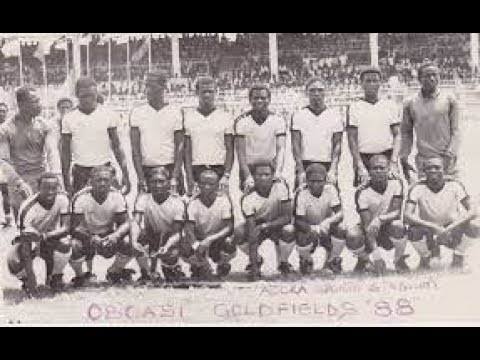
Goldfields, representing Obuasi, also demonstrated that traditional football power was not limited to Accra and Kumasi, because the club brought the football culture of the mining town onto the national stage and went on to win the inaugural Ghana Premier League title in 1993, providing an important reminder that the development of Ghanaian football has always involved clubs from different regions and communities.
Accra Great Olympics also occupies a special position in this history, having emerged from the development of earlier Accra clubs before becoming an established force in Ghanaian football, and its presence alongside Hearts of Oak helped create a competitive Accra football environment in which players had to fight for places, supporters had local rivalries to enjoy and the capital became one of the country’s most important football centres.
In the western part of the country, clubs such as Sekondi Hasaacas and Eleven Wise carried the football identity of Sekondi-Takoradi for generations, while Ebusua Dwarfs became closely associated with Cape Coast and Real Tamale United became a major representative of northern Ghana, demonstrating that the history of Ghana football is not simply the story of two famous clubs but a much wider story involving institutions that connected football to communities throughout the country.
These clubs also helped create the competitive depth that Ghana needed, because a league cannot become respected simply because two or three clubs are successful; it requires a broad network of teams with their own traditions, supporters, talented players and ambitions, and the traditional clubs provided precisely that environment during periods when professional structures were still developing.
One of their greatest contributions was player development, because many of the country’s most talented footballers first gained serious competitive exposure through domestic clubs before attracting the attention of the national teams and foreign scouts, meaning that the traditional clubs functioned not only as competitors for trophies but also as important stages in the careers of players who would later represent Ghana at major international tournaments.
The old clubs also taught players what it meant to perform under pressure, because wearing the shirt of a major Ghanaian club was never simply about completing ninety minutes on a football pitch; players were expected to deal with demanding supporters, intense local rivalries, important league matches, cup competitions and, for the biggest clubs, the additional pressure of representing Ghanaian football on the African continent.
This pressure became particularly significant when Ghanaian clubs entered African competitions, because continental football exposed domestic players to opponents from countries with different tactical cultures, playing styles, physical approaches and football traditions, forcing Ghanaian teams to develop greater adaptability and giving their players valuable experience against some of the strongest clubs in Africa.
Asante Kotoko became one of the clearest examples of this continental ambition, winning the African Cup of Champions Clubs in 1970 and again in 1983, achievements that placed the Kumasi club among Africa’s historic continental champions and demonstrated that Ghanaian club football could compete successfully at the highest level of African competition.
Those victories mattered far beyond the trophies themselves because every continental success strengthened the reputation of Ghanaian football, gave domestic players greater exposure and showed supporters that the country’s clubs could compete with powerful football institutions from North Africa, West Africa, Central Africa and other parts of the continent.
Kotoko’s African campaigns also helped create a culture in which Ghanaian clubs expected to be competitive outside the country’s borders, and that mentality became an important part of the country’s football identity, particularly because domestic dominance alone could not satisfy clubs whose ambitions extended to African glory.
Hearts of Oak eventually produced one of the greatest continental achievements in Ghanaian club football when the Accra giants won the CAF Champions League in 2000, defeating Esperance of Tunisia in the final and becoming the second Ghanaian club to win Africa’s premier club competition.
The 2000 Hearts team represented a remarkable generation of Ghanaian football talent and showed how a strong domestic club could become the platform for continental success, because the players were competing regularly in Ghana before being tested against some of Africa’s most established teams, creating a pathway in which domestic football served as the foundation for international club achievement.
Hearts’ continental success did not end with the Champions League title, because the club also won the CAF Super Cup in 2001, defeating another African champion and further establishing Ghanaian club football on the continental stage.
The club went on to add another major African trophy in 2004 when Hearts of Oak won the CAF Confederation Cup, completing a period in which the club had demonstrated that Ghanaian football could produce teams capable of competing for different continental honours rather than simply participating in African competitions.
The importance of that era is even clearer when one considers the wider Ghanaian football environment at the time, because domestic clubs were producing players who were capable of representing the Black Stars while simultaneously competing in continental club football, creating a powerful relationship between club success and national-team development.
The traditional clubs therefore became something of a football university for Ghanaian players, because young footballers could learn how to cope with tactical demands, physical challenges, hostile away environments, demanding supporters and high-pressure matches before taking the next step in their careers, and the lessons acquired in those environments could prove valuable when players moved abroad.
Another important contribution was the creation of football rivalries that helped generate public interest in the domestic league, with Hearts of Oak and Asante Kotoko becoming the most prominent example, while Great Olympics and Hearts gave Accra its own major rivalry and other regional clubs created intense local contests that kept supporters emotionally connected to domestic football.
These rivalries gave the Ghana Premier League a personality, because supporters did not simply follow football as an abstract competition but followed particular clubs whose colours, histories, symbols and traditions represented their families, neighbourhoods, towns or regions, and this emotional connection helped the league survive through periods of financial difficulty and organisational uncertainty.
Match days involving traditional clubs also became social events, particularly when major rivals met, with supporters travelling across cities and regions, radio stations building anticipation around the games, journalists analysing team selections and tactics, and families discussing football before and after matches, making domestic football an important part of everyday Ghanaian conversation.
Radio commentary played an especially important role in strengthening this relationship because, for many supporters who could not attend matches, the voices of commentators became the bridge between the stadium and the living room, allowing supporters to experience the drama of a major league encounter even when they were hundreds of kilometres away from the venue.
The traditional clubs also created employment and professional opportunities around football, because the existence of major teams required coaches, physiotherapists, doctors, administrators, scouts, kit managers, groundsmen, journalists, photographers, commentators and other professionals whose work contributed to the development of the wider football ecosystem.
Their influence could also be seen in the growth of local football academies and youth teams, because once clubs became recognised as pathways to professional football, young players and their families had a stronger incentive to invest time and effort into football development, hoping that talent discovered at a young age could eventually lead to a professional career.
Ghana’s traditional clubs also contributed to the development of football culture through their alumni, because former players frequently became coaches, scouts, administrators or mentors, carrying lessons from one generation into another and ensuring that the knowledge accumulated within the clubs did not completely disappear when individual players retired.
The domestic success of the old clubs also gave Ghanaian football a competitive benchmark, because ambitious clubs entering the Premier League knew that they would eventually have to measure themselves against institutions with decades of history, large supporter bases and experience in high-pressure matches, creating an environment in which newer clubs could gradually build their own identities.
This does not mean that the traditional clubs were always successful or that Ghanaian football developed without problems, because football institutions have experienced financial difficulties, administrative changes, periods of poor continental performance, stadium challenges, player transfers and other setbacks, but their ability to survive across generations remains one of the most remarkable features of Ghanaian football.
In fact, the long-term survival of clubs such as Hearts, Kotoko, Great Olympics, Hasaacas, Eleven Wise, Dwarfs and RTU demonstrates that football institutions can carry historical value even when their competitive fortunes change, because a club’s importance is not determined solely by its position on a league table in a particular season.
The traditional clubs also provided Ghana with a recognisable football brand across Africa, because opponents in continental competitions knew the names of Hearts of Oak and Asante Kotoko, understood their histories and expected difficult matches whenever Ghanaian champions arrived in their countries, while Ghanaian supporters similarly developed memories of famous stadiums and opponents across the continent.
Travelling for African competitions also helped expand the football education of Ghanaian players, because continental matches exposed them to different refereeing approaches, tactical systems, stadium atmospheres and styles of play, experiences that domestic competition alone could not fully reproduce.
For many players, African club football became an important stepping stone toward international careers, because strong performances against recognised continental opponents could attract scouts and create opportunities outside Ghana, meaning that the traditional clubs indirectly contributed to the movement of Ghanaian footballers into stronger leagues abroad.
The impact of these clubs can therefore be measured not only by trophies but also by the generations of players they helped produce, the coaches they developed, the supporters they inspired, the rivalries they created and the reputation they gave Ghanaian football throughout Africa.
There is also an important cultural dimension to the story, because traditional football clubs became repositories of memories, with supporters remembering legendary teams, famous goals, dramatic comebacks, controversial decisions, historic finals and great players long after those matches had disappeared from the weekly football calendar.
In Ghana, football history is often told through stories passed from one generation to another, and the traditional clubs are central characters in those stories, with fathers explaining to sons how a particular team dominated an era, grandparents recalling legendary players and older supporters describing continental nights that became permanent parts of their sporting memories.
The Ghana Premier League itself has changed considerably since its professional beginning in 1993, with new clubs rising to challenge the established giants, and the league’s champions have increasingly reflected the broader geographical spread of Ghanaian football. Clubs such as Aduana Stars, Berekum Chelsea, Ashanti Gold, Wa All Stars, Medeama, Samartex and Bibiani Gold Stars have all added their own chapters to the competition’s history.
This expansion is important because the strength of Ghanaian football should not depend permanently on only a few famous institutions, and the emergence of clubs from Dormaa, Berekum, Wa, Tarkwa, Samartex and Bibiani demonstrates how the traditional foundation created by the older clubs can coexist with a new generation of football institutions.
Yet even as new clubs rise, the traditional giants continue to carry a unique historical responsibility because their names have been associated with Ghanaian football for so long that their successes and failures attract national attention, and whenever Hearts or Kotoko enter an African competition, the conversation often extends beyond the club itself to the reputation of Ghanaian football.
That responsibility is particularly important today because Ghanaian clubs have struggled to reproduce the consistency of earlier generations in continental competitions, making the achievements of the previous era an important reference point whenever the country’s representatives prepare for CAF competitions.
The challenge, therefore, is not simply to celebrate the past but to learn from it, because the achievements of Kotoko in 1970 and 1983 and Hearts in 2000 provide historical evidence that Ghanaian clubs can reach the highest level of African football when talent, organisation, preparation, resources and competitive ambition come together.
The traditional clubs also remind the modern game that successful football institutions require more than talented players, because sustained competitiveness depends on administration, scouting, youth development, coaching structures, financial planning, quality facilities, strong supporter relationships and the ability to prepare properly for the demands of both domestic and continental football.
Ghana’s football authorities, club administrators and other stakeholders can therefore look at the history of the traditional giants not merely as nostalgia but as a source of institutional lessons, because the clubs that survived for decades did so by creating identities strong enough to withstand changes in players, coaches, competitions and generations of supporters.
The greatest legacy of the traditional clubs may ultimately be the belief they created that Ghanaian football belongs on the African stage, because before modern academies, European scouting networks and sophisticated football technology became central to player development, Ghanaian clubs were already travelling across Africa, competing against powerful opponents and proving that local talent could produce teams capable of challenging for continental honours.
Their story is therefore not simply about Hearts of Oak and Asante Kotoko, nor is it only about trophies won decades ago, because it is a story about the creation of a football culture that allowed generations of Ghanaians to identify with clubs, discover players, follow competitions, dream of professional careers and believe that football could carry Ghana’s name beyond its borders.
As Ghanaian football looks toward the future, the traditional clubs remain an important part of the country’s football foundation, and their greatest contribution should perhaps be viewed as the legacy they have left for the entire game: they helped establish the competitive culture of the domestic league, gave generations of players a platform to develop, built passionate supporter communities, created some of the country’s greatest football rivalries, carried Ghanaian football into major African competitions and demonstrated through historic continental triumphs that Ghanaian clubs could stand among Africa’s best; the task for the modern generation is to build new chapters worthy of that history, so that the names of today’s clubs, players and coaches can one day be remembered with the same pride with which Ghana continues to remember the giants who built its football tradition.