
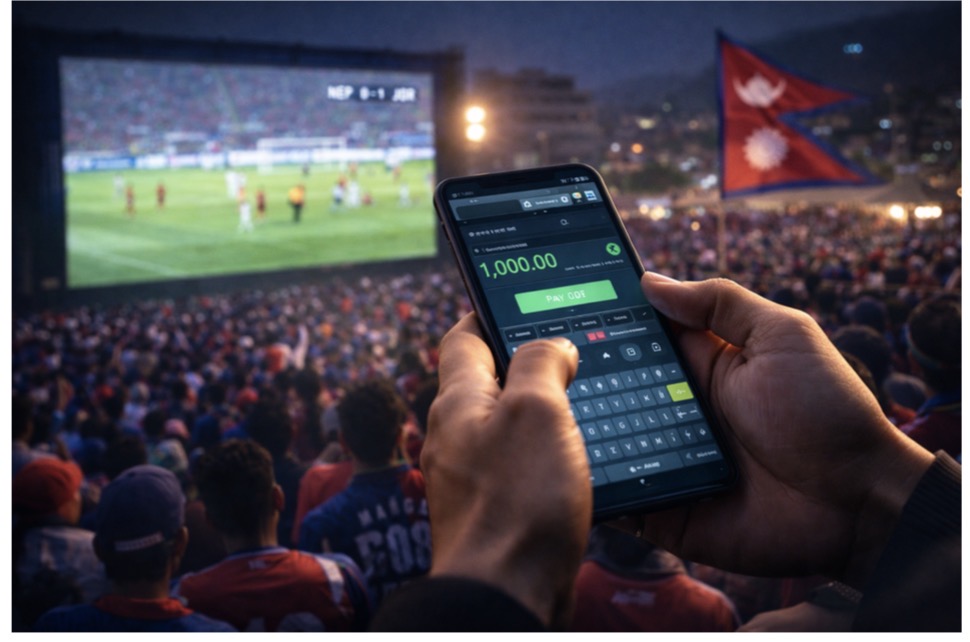
Nepal’s sports culture in 2026 is being shaped less by the television in the corner than by the phone in the hand. DataReportal’s latest country profile puts Nepal at 32.4 million mobile connections, 16.6 million internet users, and 14.8 million social media user identities by late 2025, while IFC’s 2025 digital finance study says 85.1 percent of households have access to smartphones and 95 percent of internet users go online from mobile phones.
That matters on match days because one device now carries the lineup graphic, the family chat, the stream, the wallet, and the payment confirmation. Phones run the day.
The match starts on the phone
The shift is easy to see during cricket windows. On 5 February 2026, the ICC confirmed that Kantipur TV would broadcast the Men’s T20 World Cup in Nepal, with selected matches produced locally in Nepali commentary, and Kantipur Max later said one of its two channels would carry Nepali commentary on at least 10 matches, including all of Nepal’s games.
That is not a cosmetic change; it alters how fans follow play, because a match can sit on the main screen while a second app carries score alerts and a third holds the comment thread. During a chase, that split-second use feels normal now, especially when a wicket in the 14th over sends people from the stream to the scoreboard before the replay has finished.
Clips beat the recap
Football has moved the same way, only faster. ANFA’s official platform now brings live match coverage, video, and news together in one place, and the rhythm suits a fan base that often consumes a game in fragments rather than in a single uninterrupted 90-minute sitting.
The details that spread first are usually small ones: Sujan Dangol scored from an indirect free kick in the fifth minute against Bhutan at the SAFF U-20 Championship on 23 March 2026, Bhutan went down to ten men in the 14th minute after Thinley Yezer’s second yellow, and Subash Bam added Nepal’s second in the 52nd. Two days later, Bam’s 24th-minute goal against Sri Lanka traveled just as quickly, and when Nishan Raj Lawat equalized in the 87th minute against Maldives on 27 March, the clip reached phones long before anyone sat down to read a full report.
Odds move between overs
Once sports content is organized around short checks instead of long sessions, betting behavior follows the same pattern. A fan watching Nepal’s T20 World Cup feed or tracking an AFC Asian Cup qualifier squad named by Guglielmo Arena is already moving between statistics, live scores, and payment apps, so sports betting nepal activity fits into the same thumb-led routine rather than standing apart from it. The habit is most visible when the event itself changes shape quickly: a wicket at the death, a red card, a late equalizer, or a set-piece spell can move prices before a viewer has even left the stream. In practical terms, the second screen is no longer a second screen; it is the control panel for how the match is watched, discussed, and acted on.
QR codes at halftime
Money now moves inside the same sports routine. Nepal Rastra Bank’s Monthly Payment Systems Indicators for Saun 2082 listed 27,988,708 mobile banking users and 24,439,439 wallet accounts, while the same monthly sheet recorded 63,174,594 mobile banking transactions and 40,928,768 QR-based payments; QR volume was far ahead of the 1,150,156 point-of-sale transactions recorded in the same period. That difference says a lot about user expectation in 2026: a fan leaving Dasharath Stadium, a café table, or a living room stream expects to settle a bill, top up a wallet, or move funds in seconds, not after a queue and not after a desktop login. The logic is reinforced by infrastructure changes, too, with IME Pay and Khalti merging into IME Khalti from 2082/04/01, a sign that convenience and scale are now driving the payments market as hard as sport drives screen time.
Apps that cannot hesitate
That same expectation has become unforgiving for sports apps. IFC’s 2025 study notes that access, lower data costs, QR payments, connectIPS, cardless withdrawals, and mobile wallets have all pushed digital finance forward, while Nepal’s payment system now assumes users want banking services anytime, anywhere. Speed counts. In that environment, melbet apk sits on the same demand curve as streaming and score apps, because the products that survive are those that open quickly, keep navigation simple, and let a user move from market view to deposit flow without friction while a match is still live. If the app freezes during a drinks break or takes too long to confirm a payment, the fan does not wait; the thumb moves elsewhere.
The screen never really closes
The broader culture around Nepali sport now reflects that constant return to the handset. The Nepal Super League describes itself as the country’s first and only professional franchise-based football league since its 2020 launch. ANFA pushes live coverage and rapid video distribution, and the Nepal Esports Association’s 5th Nepal Esports Championship & Expo 2025 used online qualifiers and double-elimination rounds leading into LAN finals, with titles including eFootball and PUBG Mobile.
The pattern is consistent across the field, the café, and the commute: communication and entertainment happen on the same device, and financial transactions happen on the same device as both. By 2026, Nepali fans no longer separate watching, talking, paying, and reacting into different parts of the day; the habits overlap, and sport is one of the main reasons that overlap now feels permanent.