

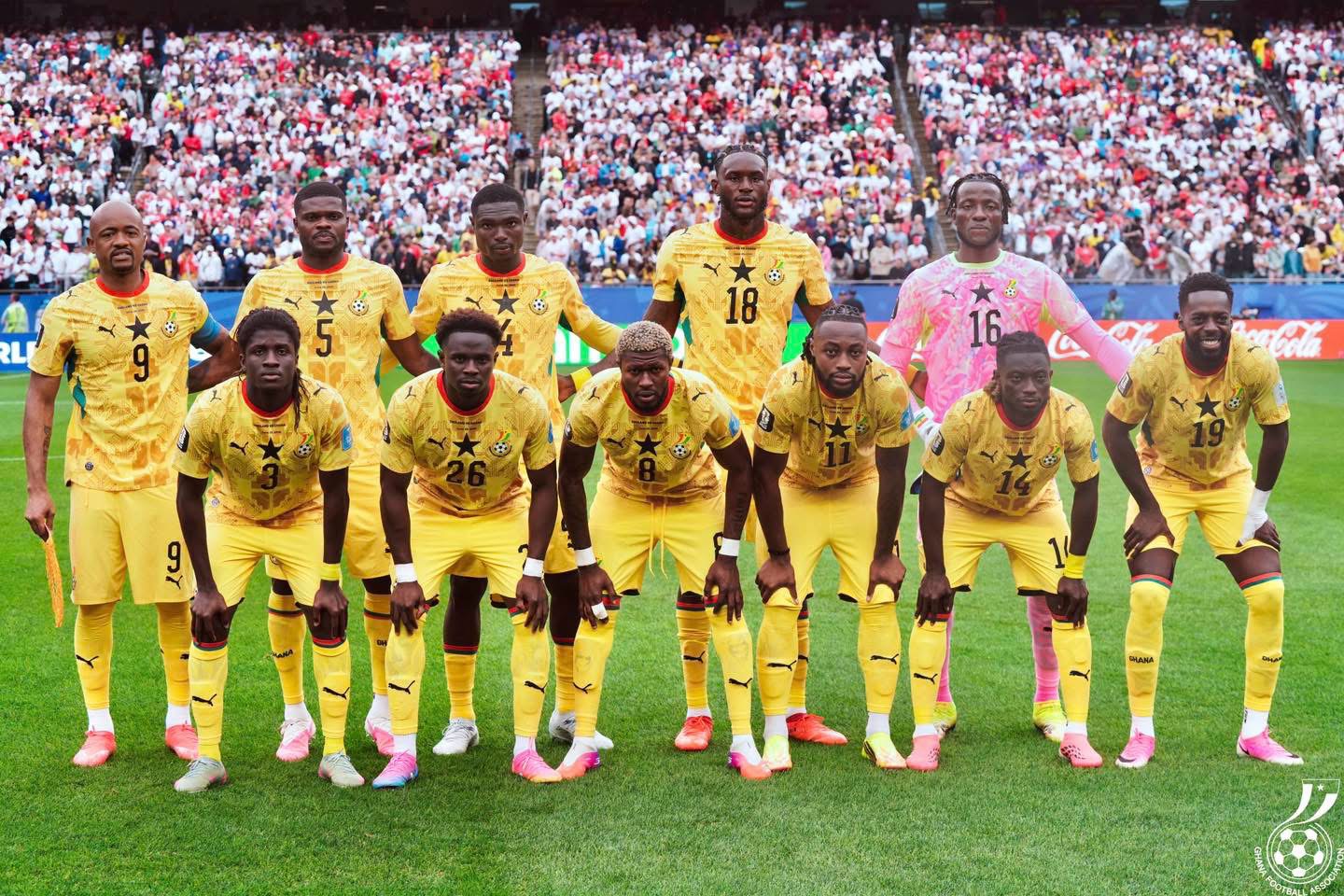
Marvin Senayah was limping. Barely able to walk, much less sprint, as the clock crept into the final minutes at Boston (Gillette) Stadium. His legs had given almost everything they had across eighty minutes of relentless, suffocating defensive work. That work had kept Anthony Gordon quiet for the better part of two hours. And now, with the game deep in stoppage time, here came Marcus Rashford off the England bench. Fresh legs against a broken body, to try one last time to find a way through.
Rashford’s cross was stifled. Same as every cross that had come before it. Same as every central thrust, every Bellingham run, every hopeful Kane shot. Ghana, yellow-shirted, gasping, and utterly immovable, held on.
England 0, Ghana 0. And it felt like a defeat for one team and a triumph for the other.
In the mixed zone afterwards, Senayah found this reporter and talked. Four months ago, he was a dependable right-back at Auxerre — solid, reliable, unspectacular, with virtually no realistic prospect of playing at a FIFA World Cup. His decision to switch nationality to Ghana came late. Very few Ghanaians had seen him play. Even fewer knew what he could bring. On Tuesday evening in Boston, he told me simply that he had wanted a chance to show he belonged. That he had something to prove. That wearing that yellow jersey meant everything.
Boy, has he made an impression. His name will not be in the headlines. No goals, no assists. But anyone who watched Ghana against England saw a man who stood between a dangerous wide forward and a goal for ninety minutes. Injured, burning, and absolutely refusing to be the reason Ghana did not get what they came for.
The Wall Queiroz Built

Senayah’s story is a microcosm of the collective. Gideon Mensah, Jonas Adjetey, and Jerome Opoku were gladiatorial. Each of them carries the particular motivation of men who have been publicly doubted, who know what it feels like to see their names typed as questions rather than answers in Ghanaian football banter.
Mensah was candid about it during his press engagement. He knows the narrative that follows him into international football. The expectation in certain corners of Ghanaian football opinion that an opposing winger will find a way past him, that he represents the weak point, and that his inclusion is always provisional. Against Noni Madueke for sixty minutes, and then against Bukayo Saka when Tuchel reached for his bench, Mensah was immovable. He did not just defend. He relished it.
This was the spirit Queiroz had spent two weeks manufacturing. First in Cardiff, then in Alexandria, then in Providence. The conditioning blocks that players compared to pre-season. The nutritionists, the physical coaches, the closed sessions, the meticulous attention to the body of each player in a squad that the Portugal coach had determined was not at the physical level his system demands. Those decisions, questioned at the time as extreme for a team with so little preparation time, were answered on the pitch on Tuesday evening.
Because to play the way Ghana played against England, you must be fit. Not match-fit in the conventional sense. Systemically fit. Capable of holding a defensive shape at high intensity for ninety minutes without the lines breaking, without the gaps opening, without the legs turning to lead at precisely the moment an opponent finds another gear. England had 72 per cent possession and 19 attempts at goal to Ghana’s 2. For the entirety of that statistical dominance, Ghana’s defensive structure did not collapse. That is not an accident. That is the product of weeks of physical investment paying its dividend at the most important moment.
Partey and the Engine That Ran the Machine
Thomas Partey’s return was not simply significant in footballing terms. It was transformative. The absence against Panama had been visible in every moment Ghana needed someone to read a danger before it became a crisis. To intercept the pass, to position the press, to organise the shape without the ball. Against England, that function was restored.
Queiroz deployed Partey alongside Kwasi Sibo and Caleb Yirenkyi in a midfield three designed specifically to close the central spaces through which Bellingham and Rice do their most dangerous work. The three of them rotated and covered with an intelligence that left England, with their attacking players unable to get close enough to the goal for extended periods, resorting to the peripheral. Wide crosses, set pieces, long-range efforts. The famous England wide threat was neutralised because the central routes were sealed. When the width was forced, Senayah and Mensah were there.
The tactical rigidity frustrated England visibly. Bellingham had a shot blocked, Rice headed over from a Madueke cross, and Kane was denied twice by Ghanaian defenders in the first half alone. The Three Lions became one-dimensional. Their best players touched the ball in spaces where it could not directly threaten. Jude Bellingham, awarded man of the match in a decision he himself said he did not deserve, spent the evening trying to unpick a combination lock without the code.
The Penalty That Wasn’t

Late in the game, as England pushed for the winner and the spaces behind finally began to open, Ghana fashioned its clearest opportunity. Eze was caught on the ball by Fatawu, who played Adu clear over the top. Konsa slid in and appeared to catch Adu. It was a stonewall penalty, clear to everyone in the stadium and on the replays. The Honduran referee gave nothing. The moment passed. Ghana scrambled from the rebound. The offside flag eventually ended the sequence. But for a few seconds, Ghana had glimpsed a win that would have sent shockwaves across the entire tournament.
They will not be losing sleep over the decision. A point from Group L’s most formidable match, with their best display yet, and a place in the top two heading into the Croatia game. This is the position that felt impossible when Queiroz signed his four-month contract and the cynics said his job was simply to prevent humiliation.
The Converts Are Multiplying
There is a word that belongs to this Ghana team now. Two, in fact. Mean and miserly. In tournament football, that combination has a history of going further than anyone predicted. Rajevac knew it in 2010. Queiroz, who spent his career building exactly these kinds of teams, has always known it. The players, many of whom spent the week before this game reading their own premature obituaries on social media, know it now, too.
England’s difficult second game afflicted them for a fourth successive tournament as Ghana frustrated Thomas Tuchel’s side to a 0-0 draw, leaving the group wide open. Ghana sit level on points with England at the top of Group L. Win over Croatia, and the Black Stars are through.
Not many teams will fancy playing this version of Ghana. They defend with collective fury and personal motivation. They work until their legs go, and then they work a little more. And somewhere in that shape — compact, disciplined, waiting — Antoine Semenyo is ready to run at whatever is left of you.
The believers are growing. The unbelievers are converting. Tuesday night in Boston did that.
Source: Godfred Boafo| Substack